
 Overview
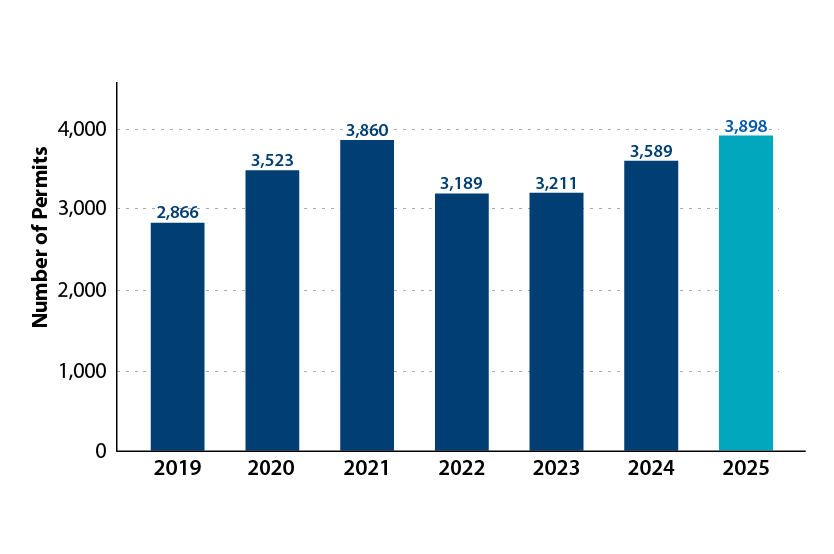
The Greater Omaha Metro issued 3,898 total building permits in 2025 — the highest volume since 2021’s post-COVID surge — reflecting continued strength in both residential and commercial development. Total permitted construction value reached $1.42 billion, down from $2.03 billion in 2024, though that figure was inflated by several outsized projects in the prior year. Normalizing for large one-off projects, 2025’s activity profile reflected a healthy, broad-based market.
The January 2026 report offers an early and compelling read: 306 total permits worth $231.6 million, one of the highest single-month values on record. The growth was primarily driven by a large new commercial construction project breaking ground.
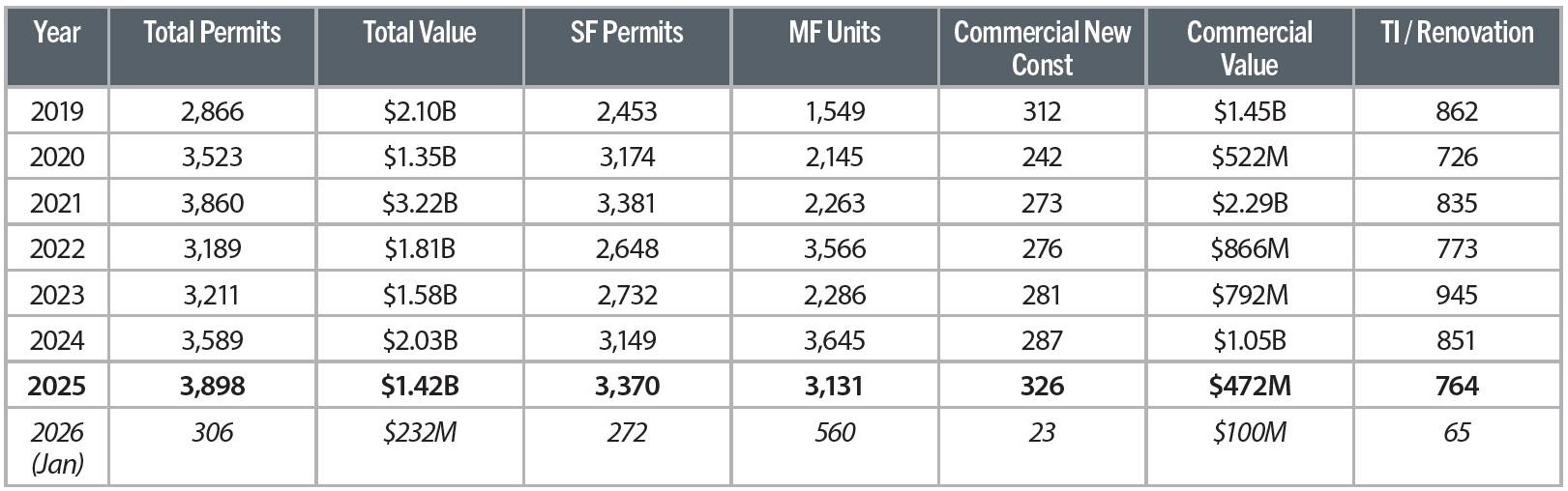
MF = Multifamily; TI = Tenant Improvements & Renovations. Commercial New Const = Non-Residential New Construction permits; value reflects commercial new construction only.
GREATER OMAHA CSA – TOTAL ANNUAL PERMIT VOLUME
Single-Family Residential
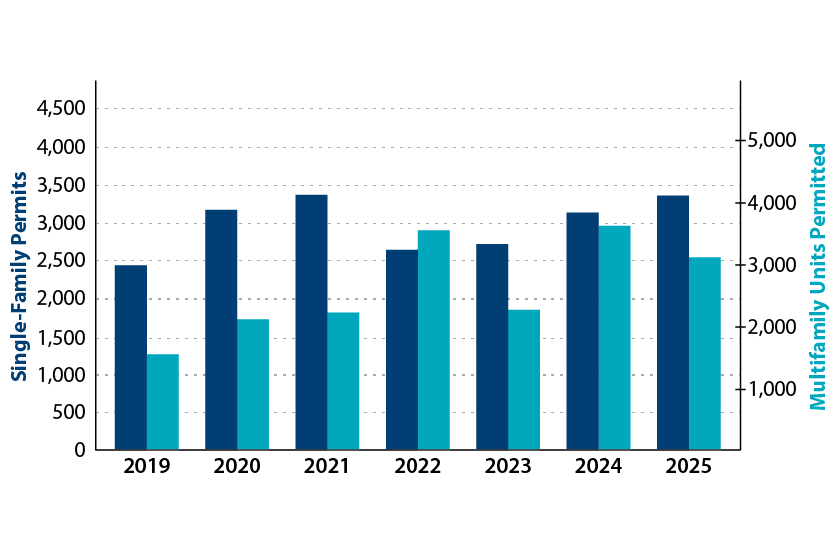
Single-family is the engine of the Omaha metro market — and in 2025 it ran near full throttle. With 3,370 permits issued at a total value of $656 million, single-family construction posted its second-strongest year of the past decade, trailing only 2021’s pandemic-driven peak of 3,381 permits.
For the past six years, permit volume remains above 3,000 permits per year. This trend reflects durable demand fundamentals: in-migration to the metro, continued suburban land absorption in Sarpy and Douglas counties, and limited resale inventory pushing buyers toward new construction.
Cost-per-permit has also risen steadily, from roughly $195,000 per home in 2019 to $195,000+ in 2025,a sign of persistent construction cost inflation.
GREATER OMAHA CSA – RESIDENTIAL ACTIVITY
January 2026 Early Read: January 2026 showed a 19% permit count decline year-over-year, with 272 single-family permits ($45.7M) vs. 337 permits ($50.2M) in January 2025.. January is historically volatile, but this pullback is worth monitoring as additional 2026 data becomes available.
Multifamily
In 2025, multifamily permits increased to 205 (from 155 in 2024),while total unit volume declined slightly to 3,131 (from 3,645).The shift reflects a change in project mix. Last year saw more mid-sized developments, while 2024 was characterized by fewer, larger projects. Total permitted multifamily value last year reached.
The current pace of more than 3,000 units per year aligns with fundamentals. Vacancy rates remain tight, and the gap in single-family ownership continues to drive rental demand.
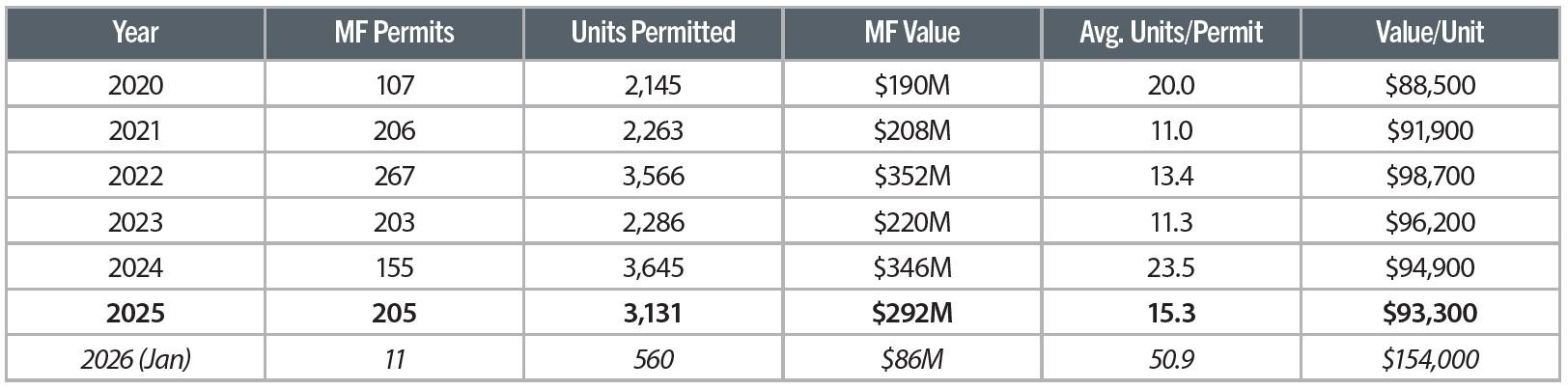
January 2026 Multifamily Flash: Eleven permits were issued, totaling 560 units and $86 million in value. January 2026 alone represents nearly 18% of all 2025 multifamily units in just 31 days.
Commercial New Construction
Commercial new construction (Non-Residential New Construction) is the segment most closely watched by CRE investors, lenders, and brokers. What we saw in 2025 was a nuanced picture.
On a permit count basis, activity increased: 326 permits versus 287 in 2024, the highest count in three years.
On a value basis, however, total permitted value fell to $471.5 million(from $1.05 billion in 2024), as the mix shifted away from the outsized industrial, institutional, and data center projects that inflated the prior year.
Viewed over a five-year horizon, the $400M–$550M range appears to be the market’s normalized base for commercial new construction value in non-spike years. Activity from 2025 was in line with historical norms.
GREATER OMAHA CSA – COMMERCIAL NEW CONSTRUCTION
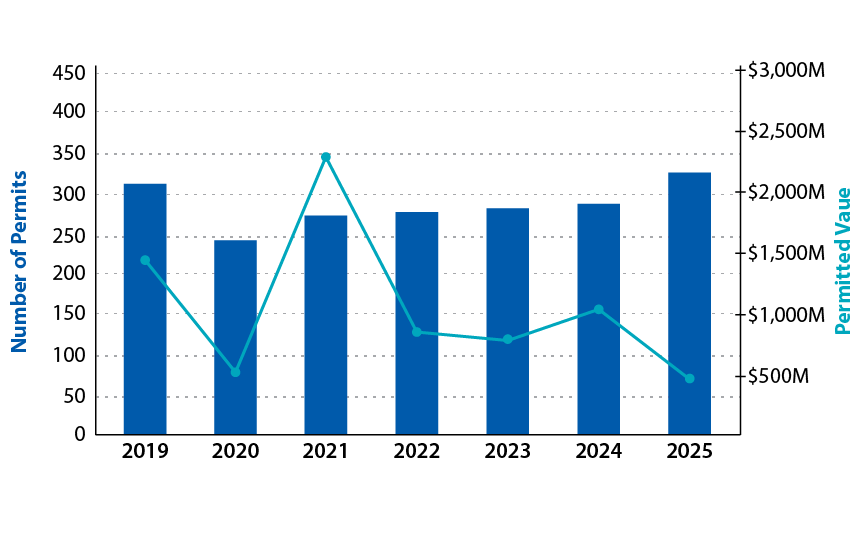
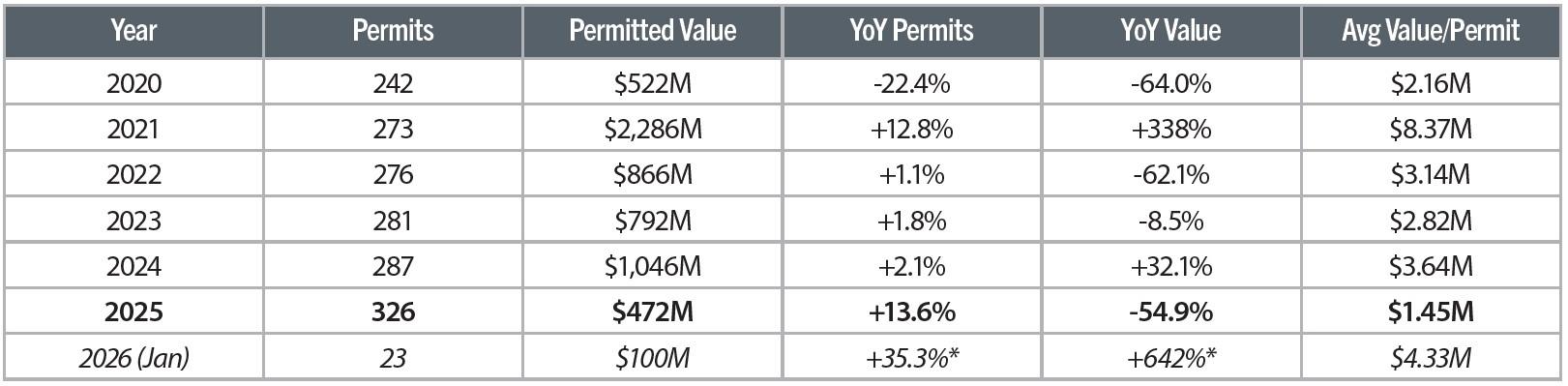
* January 2026 vs. January 2025 year-over-year comparison.
January 2026 Commercial Flash: Commercial new construction in 2026 could rebound sharply from 2025’s decline if current pace continues. In January 2026 posted a 642% jump in permitted value (compared to January 2025), with 23 permits worth $99.6 million. One or more major commercial projects appear to have broken ground at the start of the year.
Tenant Improvements & Renovations
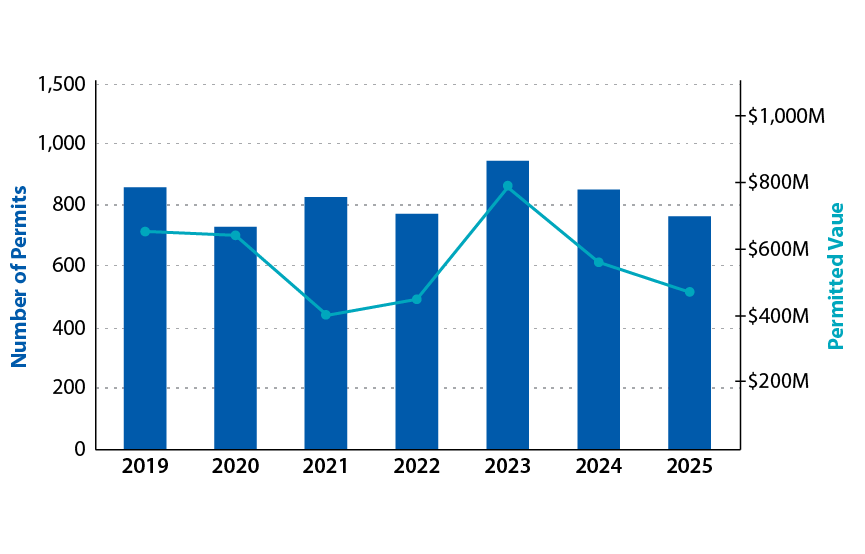
Tenant improvement (TI) and renovation activity (Non-Residential Finish & Improvement) serves as a real-time indicator of occupier confidence — businesses expanding, refreshing, or repositioning existing space. In 2025, the market issued 764 TI/renovation permits at a total value of $473 million, normalizing from the elevated 2023 levels that reflected a wave of post-COVID office and retail repositioning.
The market has stabilized in the $450-560 million range over the past two years, which reflects steady leasing activity and thoughtful tenant decision-making compared to the urgency that drove the previous spike in 2023.
GREATER OMAHA CSA – TENANT IMPROVEMENTS & RENOVATIONS
Total Construction Value by Category
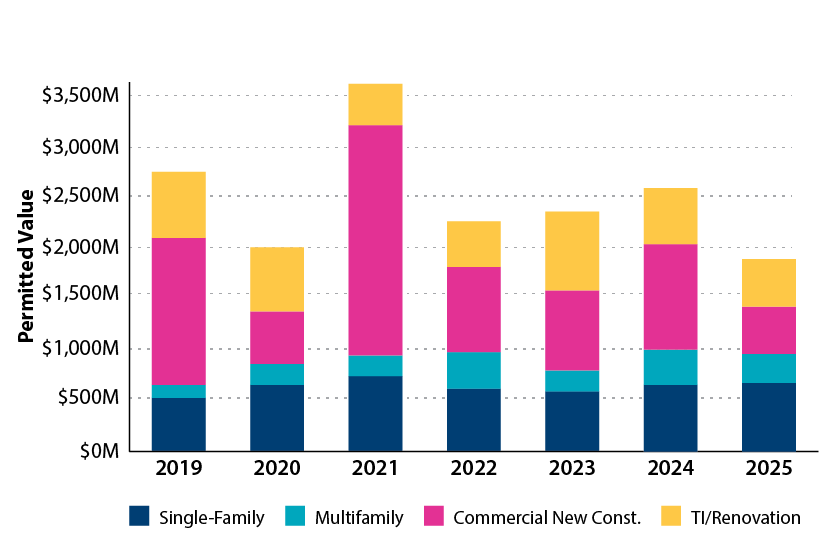
The stacked chart below illustrates how each segment contributes to total permitted construction value annually. The dominant role of commercial new construction in high-value years (2019, 2021, 2024) is clearly visible, as is the relative consistency of single-family as the market’s backbone. Multifamily’s growing share in 2022–2024 reflects the apartment pipeline that has been building across the Omaha Metro.
GREATER OMAHA CSA – TOTAL CONSTRUCTION VALUE BY CATEGORY
Key Takeaways for Investors & Market Participants
- Residential demand remains robust
- Single-family permits remain near multi-year highs at 3,370, while multifamily permits number 3,131 units. This keeps rental supply growth at a healthy pace without oversaturation.
- Commercial took a value breather in 2025
- Permitted commercial value fell to $472M from $1.05B, but permit count rose to 326 — the highest in three years. Smaller-scale projects are proliferating even as large deals slowed.
- TI activity has stabilized
- At $473M and 764 permits in 2025, TI/renovation spending has settled into a healthy range after the 2023 repositioning wave — a sign of ongoing occupancy activity rather than crisis-driven churn.
- Watch January 2026 closely
- A $231.6M total value month — well above the 2025 monthly average of $118M — signals significant projects are mobilizing early. The January commercial flash ($99.6M) and multifamily flash (560 units) both warrant monitoring.
This article appeared in our company newsletter in June 2026. Please click here to download the entire newsletter.